[first published 18.01.2025 Substack]
The Mukbezumps are officially taking control in a couple of days. I share the alarm and dread, a feeling that is exacerbated by almost everything I see and hear in the screenified world. People who know way more than me about these things and can write more thoughtfully about them, include: Brian Merchant, Paris Marx, Laurie Stone, Molly Crabapple). David Lynch has joined the mystery and Eraserhead, well, that’s for another time. Today, it’s birds, bees and flowers. Mainly.
There’s a banksia (species robur, Latin for ‘strength’) in front of my house. My mother gave it to me and my bloke a couple of years ago. At other times she also gave us a peppercorn tree, a magnolia grandiflora and a Japanese maple – all these trees are thriving, and I think of her when I look at them. But, as it’s only been six months since she died, I think of her in a glancing way and manoeuvre my mind elsewhere. Her absence still hurts in a disabling way and even now, writing this, I feel my thoughts stepping carefully, like walking along a log across a rushing creek. I steer my mind to the fact that my mother loved to look closely at plants, flowers, birds; she loved to understand how things work.
So I’ve been checking the way the banksia robur’s flower-cone-thingos change as they develop and there’s a lot going on – colour, texture, structure – there. When the flower-cone-thingo (henceforth – conflorescence) begins to form it goes from a rich mid-green, to very surprising intense aqua blue tips with pink in the inner part of the ‘cone’, to a cheerful light green, to yellow deepening to brown.
When they start to form, the conflorescence (flower spike?) looks like it has been machined on a lathe, so precisely laid out is its cylindrical patterned form. It begins to look a bit medieval weaponry-adjacent – knobbly, with intent to harm. A bit later it goes through a shaggy, almost furry stage, then it’s kind of wiry-looking, then somewhat fluffy. When it starts to brown off it gets dishevelled but sits there in the fork of its branch, stubbornly bristled.
I tracked down a helpful diagram on the Australian Native Plant Society’s website to explain just why these plants go through so many fashions. First, it helps to know that the flower-cone-thingo of banksias is actually densely packed individual flowers radiating out from a central axis in a spiral. A banksia conflorescence can be made up of hundreds (sometimes thousands, depending on the species) of these little flowers, each of which, when in bud form, is called a perianth. The perianth is a tube with a little rounded end, and together these hundreds of budding perianths form that precise-looking lattice that spirals up and around the woody centre (the lathe-machined stage).
Each perianth is made up of four anthers (the pollen-producing parts) which split apart… but wait, before they split (remember: hundreds, or thousands, of these on each conflorescence), there is a long thin ‘style’ inside the perianth as well as the anthers, and in pushing its way out, it curves upwards, touching the pollen at the tips of the anthers on its way. This stage is when banksias look their most wiry, and one species – Banksia spinulosa – is commonly called ‘hairpin banksia’ because it looks like someone has stuffed a whole lot of old fashioned bent hairpins into it.
Having collected its blob of pollen, the style boings out of the perianth (I imagine there’s some kind of release of tension that might make at least a very tiny ‘ping’) and sticks straight out. Now it’s known as a ‘pollen presenter’. So polite.
The hundreds/thousands of these pollen presenters give the banksia flower spike its bristly look, holding out pollen for the insects, birds and little furry creatures that come to feed on all the nectar and pollen on offer. Some botanists consider that the rummaging of creatures stimulates the perianths to split open and let the anthers and styles get together. Boing. Ping.
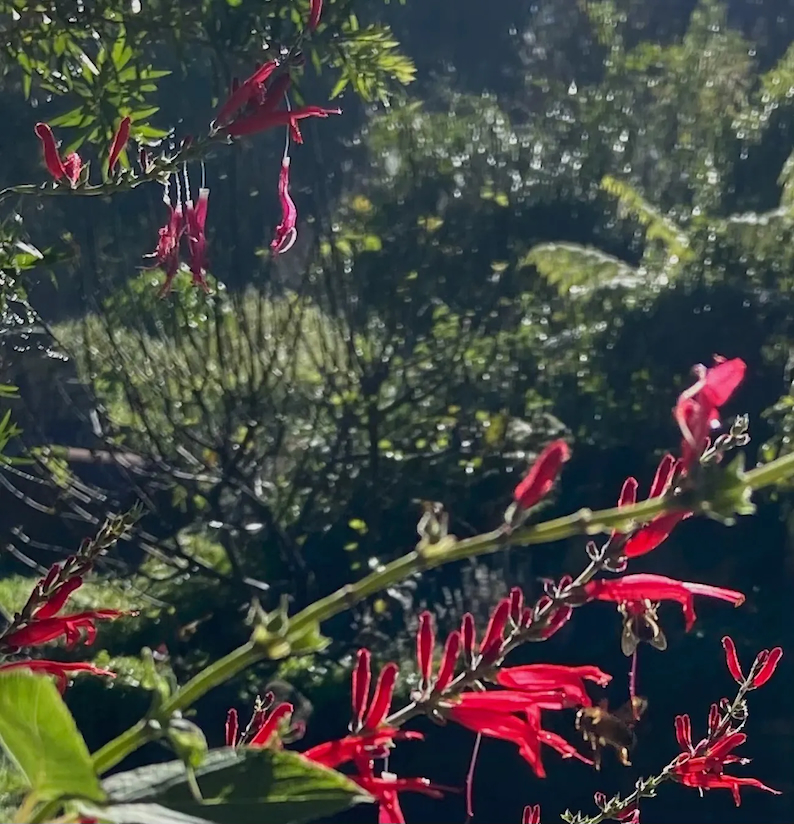
I’ve watched bees bumping each other out of the way to get to nectar payloads inside the crimson flowers of a salvia plant. It was a bright clear blue April sky – autumn where I live. The day before I’d noticed little flaccid salvia blossoms dangling from their stems – connected only by the thinnest thread of stamen – and wondered how they’d become dislodged in such a weird way. Turns out, it was the bees’ fault.
A bee pokes its head into the long tube flower – the flower is longer than the bee – to get to the base where the nectar sits. Its hooked feet struggle to get a grip on the opening of the blossom. It keeps pushing its big head into this narrowing tunnel and at that moment the low autumn sun shines through the flower and the bee is backlit – its pointy tongue silhouetted inside the petals. As it pushes to get those last little nectar droplets, I see that the flower just neatly unzips. It’s kind of sexy. And funny and delightful.
Bees, eager and avid, caused the salvia to end up covered in unzipped blooms hanging limply from their tiny but strong stamens. They looked like party streamers and deflated balloons, the morning after. When the emptied flowers finally fell from the plant, the bees did a final check, busy between the fallen petals, sipping the dregs.
The main feeders on the banksia robur are little brown, black and white birds called Eastern Spinebills. They can hover while feeding, a bit like a hummingbird, and the end of their long tongue is like a little brush which can sop up nectar at the base of the banksia flowers. While they’re at it, they receive a dusting of pollen on their heads, to transfer to the next flower-cone-thingo they visit.
Tonight I will watch the news and the dread will come back into sharp focus; the Mukbezumps will be a little further along their campaign of domination. Later I’ll read the articulate commentators and try to get to grips with what I can, usefully, do. Later still, I’ll wake up and remember, again, that my mother is no longer alive. Tomorrow I’ll wait for the pollen presenters to greet the spinebill, and be happy to be able to do this, just as my mother would want me to be.